

Ideas and advice
What do you put between stone pavers?
The short answer
It depends on what is under the pavers. Pavers laid on sand or crushed rock move a little, so the joints need a filler that can move with them. Pavers stuck down on mortar over a concrete slab do not move, so the joints can be filled solid with a grout or mortar.
Find out which you have before you buy anything. If you are not sure, lift one paver at the edge or ask whoever laid them.
Pavers laid on sand or crushed rock
Jointing sand. Fine dry sand swept into the joints. It is the cheapest option and easy to top up. It can wash out in heavy rain, and weeds and ants can get into it, so expect to sweep more in from time to time.
Polymeric sand. Sand with a binder that sets when you wet it. It holds better than plain sand and resists weeds and ants, while still allowing a little movement. Each brand has its own limits on joint width and depth, so read the bag. Sweep the surface completely clean before you wet it, or it can leave a haze.
Brush-in jointing compound. A ready-mixed compound, usually sold in a tub, that you sweep into wet joints. It sets firm but lets water drain through, so it suits paving on a free-draining base. Most are made for foot traffic. Check the maker's advice before using one on a driveway.
Pavers bedded on mortar over concrete
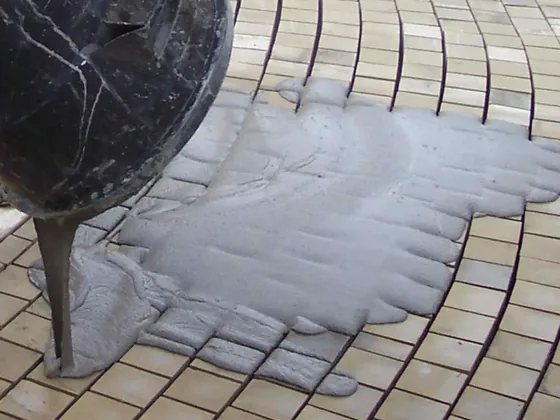
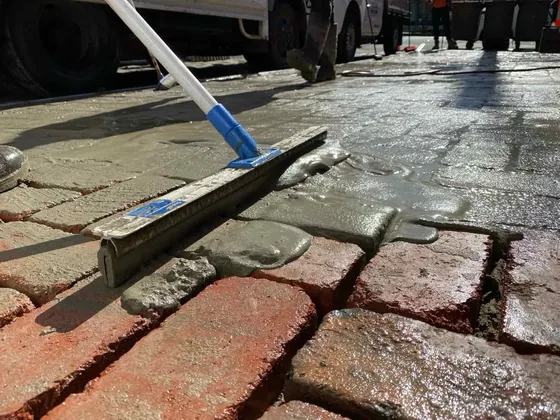
Pour-in grout (also called slurry grout). A cement grout mixed to a pourable liquid. You pour it across wet paving, squeegee it into the joints and wash the surface clean. It fills each joint to the bottom and sets hard. Flowpoint is this type: it fills joints from 2 to 50 mm wide and at least 20 mm deep, takes foot traffic after about 1 hour and vehicles after about 4 hours at 20°C. It is fast on a large area, but you need to work quickly and wash off thoroughly.
Wide joint grout. A cement grout mixed to a paste and worked into each joint with a rubber float, like tiling. Examples are ARDEX WJ 50 (its maker lists joints from 2 to 50 mm) and Dunlop Wide Joint Grout (5 to 50 mm). It is slower than pouring, but gives you more control on a small area, on steps and on walls.
Sand and cement mortar. Mixed on site and pressed into the joints with a pointing trowel. It is the traditional way and costs little. It is slow, it can stain the stone if it smears, and it can shrink and crack if the mix is too wet.
Which one for your job
- Pavers on sand, light use: jointing sand or polymeric sand.
- Pavers on a free-draining base, patio or path: brush-in compound.
- Pavers on a concrete slab, large area or a driveway: pour-in grout.
- Pavers on a concrete slab, small area, steps or a wall: wide joint grout or mortar.
Where a pour-in grout is the wrong choice
Do not use a pour-in grout on pavers laid on sand. The joint sets rigid, the pavers still move, and the grout cracks. It also needs a joint at least 20 mm deep, so it does not suit thin tiles.
What Romano can help with
Flowpoint is made in the UK by Instarmac. Prolific Stone International is its exclusive Australian distributor, and Romano stocks it. We supply it with our natural stone pavers, so the stone and the grout arrive together. Tell us how your pavers are laid, the paver size and the joint width, and we will tell you what suits and how much you need. Call 03 9720 4633.
Read next: Flowpoint paving grout, How to use Flowpoint, Natural stone paving, Crazy paving.